
Due to the aforementioned series of physical and chemical properties of natural rubber, especially its excellent elasticity, insulation, water resistance, and plasticity, as well as the valuable properties such as oil resistance, acid resistance, alkali resistance, heat resistance, cold resistance, pressure resistance, and wear resistance after appropriate treatment, it has a wide range of applications. For example, rain boots, hot water bags, and elastic bands used in daily life; surgical doctor gloves, infusion tubes used in the medical industry; various tires used in transportation; conveyor belts, transportation belts, acid and alkali resistant gloves used in industry; irrigation and drainage rubber hoses, ammonia water bags used in agriculture; sounding balloons for meteorological measurement; sealing and shock-proof equipment for scientific experiments; aircraft, tanks, cannons, and gas masks used in national defense; even becoming indispensable raw materials for high-tech scientific and technological products such as rockets, artificial earth satellites, and spacecraft. Currently, there are more than 70,000 items in the world that are partially or entirely made of natural rubber.
The uses of rubber are extensive. It plays a role in almost every sector of the national economy and has close connections with all industries.
(1) Rubber and Transportation: The rubber industry developed along with the automotive industry. In the 1960s, the automotive industry and the petrochemical industry experienced rapid growth, which significantly improved the production level of the rubber industry. In the 1970s, to meet the needs of automobiles for high speed, safety, energy conservation, pollution elimination, and prevention of public hazards, new types of tires were constantly emerging. Raw rubber consumption accounts for a considerable proportion in transportation. For example, a Liberation 4-ton heavy-duty truck requires over 200 kilograms of rubber products, a hard-seat carriage needs a total weight of over 300 kilograms of rubber products, a 10,000-ton ocean-going vessel requires nearly 10 tons of rubber products, and a jet airliner requires nearly 600 kilograms of rubber. In all modes of transportation - sea, land, and air - rubber products are indispensable. As a means of transportation, tires are a major component. In recent years, in addition to producing ordinary tires, radial tires, and tubeless tires have also been vigorously developed. Rubber tires have been adopted in subways as well. Rubber springs and other rubber-based products have been widely used in railway vehicles and automobiles. Large stores, stations, and subways have also adopted passenger transportation belts. Moreover, there are rubber-made "airship" and "aircraft" as well.
(II) Rubber and Industrial Mining: The industrial sector requires an even greater variety and quantity of rubber products, ranging from small to large sizes. They come in numerous types and have wide applications. Some even have specific requirements. The main products include adhesive tapes, rubber hoses, sealing gaskets, rubber rollers, rubber plates, rubber linings, and labor protection equipment. In the fields of mining, coal, and metallurgy, rubber is used for transporting finished products. Such applications are constantly emerging in various regions. To meet the needs of large-scale production, steel wire rope core transportation belts and synthetic fiber transportation belts have also been produced. In recent years, rubber linings for mining mills have been used, replacing manganese steel with forged rubber, which has increased the service life by two to four times and reduced noise. This product has been widely promoted worldwide.
(III) Rubber and Agriculture, Forestry, Water Conservancy: The development of agriculture, forestry, water conservancy and related industries also requires a wide variety of rubber products. Apart from various tires for tractors and agricultural machinery, rubber tracks needed for combine harvesters, rubber anti-seepage layers and rubber dams used in irrigation water tanks, reservoirs, rubber boats, life-saving equipment, etc. are all increasing. Rubber parts are also used in agricultural processing equipment and technical equipment for forestry, animal husbandry and fishery. For example, a 40-type wheeled tractor requires as many as 121 rubber products. With the development of agricultural mechanization and large-scale water conservancy projects, the demand for rubber products will continue to increase.
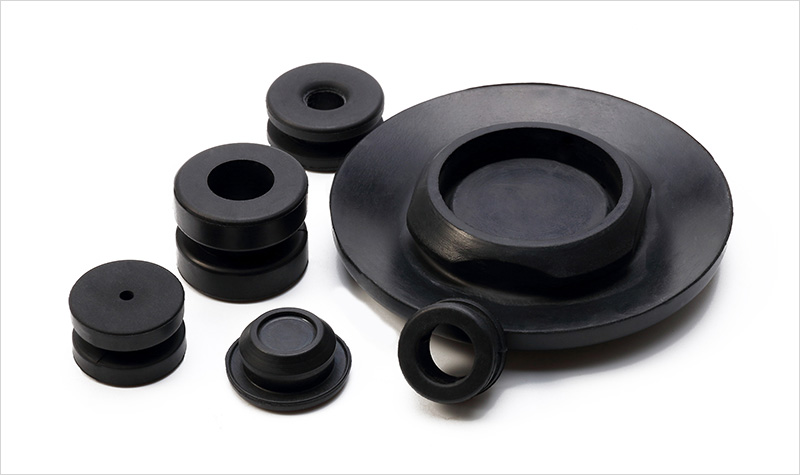
(4) Rubber and Military Defense: Rubber is an important strategic material and its application in military defense is extremely extensive. For instance, a tank requires over 800 kilograms of rubber; a general 30,000-ton warship needs 68 tons of rubber. Rubber can be found in almost all military equipment, air force facilities, and defense projects. There are also many varieties of rubber-made vessels, tents, warehouses, protective equipment, and bathing suits. Moreover, rubber products with special properties such as high-temperature resistance, low-temperature resistance, oil resistance, and high vacuum resistance, which are necessary for safeguarding cutting-edge technologies, are indispensable. With the development of modernization in national defense, rubber products that can withstand a temperature range of -100 to 400 degrees Celsius and can resist various acids, alkalis, and oxidants with special properties are being developed and produced.
(5) Rubber and Civil Construction: In modern buildings, rubber plays an even more significant role. For instance, the rubber strips used for sealing glass joints on buildings, soundproof floors, felt carpets, rubberized carpets, rainproof materials, and coatings for walls. Since the mid-1960s, large rubber spring seat cushions have been installed in buildings to reduce vibrations and noise caused by subways. Foreign countries are also developing rubber seat cushions that can mitigate the damage to buildings caused by earthquakes. The research and development of such rubber products is of great significance. The use of inflatable rubber soft rubber cement and rubberized gypsum in manufacturing hollow concrete components is becoming increasingly widespread in construction projects. Mixing rubber latex into cement can enhance the elasticity and wear resistance of the cement. Adding 3% of rubber or rubber latex to asphalt for paving road surfaces can prevent cracking of the road and improve impact resistance. In construction, various machinery, transportation equipment, and protective equipment used in construction all have rubber products as accessories.
(6) Rubber and Electrical Communication: Another characteristic of rubber is its excellent insulating property, which makes it highly resistant to electricity. Various wires and cables are mostly made of rubber. Hard rubber is also commonly used to manufacture rubber tubes, rubber rods, rubber plates, partitions, and battery cases. In addition, it is widely used as insulating gloves and insulating rubber boots/shoes for protective purposes.
(7) Rubber and Healthcare: In the healthcare sector, numerous rubber products are in use, such as in the anesthesia department, urology department, surgery department, neurosurgery department, orthopedics department, gynecology department, radiology department, etc. Various rubber surgical gloves, ice packs, sponge seat cushions, etc. used for diagnosis, blood transfusion, catheterization, gastrointestinal cleansing, etc. are mostly rubber products. As accessories for medical equipment and instruments, there are also rubber products. Medical rubber products often have specific requirements, such as being non-toxic, bactericidal, having physiological inertness, and being resistant to radiation. Butyl rubber for rubber towels has high biological inertness, chemical stability, and relatively low water permeability and breathability. When used to process rubber stoppers, it can ensure the preservation of high-hygroscopic, anti-bacterial, and anti-cancer preparations. In recent years, silicone rubber has become increasingly widely used in the manufacturing of medical products. For example, the use of silicone rubber to manufacture artificial organs and substitutes for human tissues has made significant progress. It is also used to make drug capsules, which are placed in the appropriate position in the body, allowing the drugs inside to be slowly and continuously released, which can improve the therapeutic effect while being relatively safe.
(8) Rubber and Commodity Storage: Rubber is not only used in medical and hygiene fields, but also in the storage of fruits and vegetables. Since 1954, controlled atmosphere technology has made significant progress and rubber films have been widely used to regulate the gas environment for storing fruits. Silicone rubber has excellent permeability to CO2 and O2 and an appropriate permeability ratio. The ratio is 6:1, which means that the diffusion speed of CO2 through silicone rubber is six times faster than that of oxygen. Compared with polyethylene plastic films, the diffusion of CO2 and O2 through silicone rubber is about 200 times faster. Depending on the differences in the respiratory intensity and quantity of various fruit and vegetable varieties, various sizes of silicone rubber containers are made and embedded on the plastic film control layer, so that the bag can maintain an appropriate amount of CO2, creating a favorable gas storage environment, thereby inhibiting the respiratory intensity of fruits and vegetables, slowing down the metabolic rate, delaying the ripening process of fruits and vegetables, reducing water loss and preventing spoilage. From the comparison of storage experiments of apples, when stored in plastic film packaging for five months, the natural consumption is less than 0.7%, and the unused natural consumption can reach 5.83%. For example, using silicone rubber film for controlled atmosphere preservation of red tomatoes, the preservation rate of all green tomatoes after one month reached over 70%, with a weight loss of 3.6%. After taking them out, all the fruits can turn red and mature normally. Without controlled atmosphere, tomatoes will turn red and mature within one week and cannot be stored any longer.
(IX) Rubber and Cultural, Educational and Sports Products: Various ball cores, sponge surfaces for table tennis rackets, swimming paddles, toy balls, pen cores for gold pens, erasers, rubber bands, rubber straps, rubber stamps, rubber cloth, balloons, and sponge pads, etc., are widely used in cultural and educational institutions, offices, design and drawing, as well as sports equipment.
(10) Rubber and Daily Products: In our daily lives, there are many rubber products serving us, and they are widely used by both urban and rural residents. It is one of the rubber products with the largest consumption volume. Others such as raincoats, hot water bottles, rubber belts, children's toys, sponge cushions, and latex impregnated products all play their roles in people's lives.
Dongguan Chang'an Yongyong Silicone Rubber Products Co., Ltd. is mainly engaged in the research, development and manufacturing of silicone and rubber products. It provides systematic services ranging from material development, mold development to the manufacturing of silicone rubber products. By mastering the technology of silicone rubber materials and controlling the accuracy of molds, it focuses on solving various difficult problems that customers are concerned about regarding the sealing, waterproofing, oil resistance, aging resistance, high and low temperature resistance, whitening, damage, cracking, wear resistance and environmental protection of silicone rubber products. Consultation Hotline: 0769-85536776


